
By Dinesh Ramasamy, Javier De Esteban | Download this article (PDF)
The US power market is at a fascinating moment of development, as new technologies drive a surge in demand for electricity just as the existing network for transmission and generation weakens. This shift may represent an opportunity for those investors with a disciplined and focused strategic approach.
The growing data demands of artificial intelligence have been well flagged, but there is a striking chart that really brings home just how staggering the upcoming challenge is expected to be. While the pace of data usage has steadily stepped up over the past decade, as the global use of social media, online streaming, and video-calls have increased, this increase is nothing like what is to be expected in the coming 10 years. Data consumption in 2030 alone is projected to match the total utilized from 2013 to 2022.

For investors, this expected surge in demand may create an exciting opportunity, but their main question will always be, “What is the most effective way to play into this trend?”
In previous tech revolutions, whether the advent of the telephone in the early 1900s or the adoption of the internet in the late 90s and early 2000s, a ‘picks-and-shovels’ approach of focusing on infrastructure assets that enable the new technologies, rather than investing in the technologies themselves, can be particularly interesting.
For example, when it comes to AI few investors have the insight to understand exactly which large language model is likely to become the most successful, or the technical understanding to know which graphics processing unit may deliver the most efficient power. But investing in the infrastructure that supports the technological revolution can prove fruitful no matter which new chip or language model comes out on top.
This means focusing on:
- Renewables and power generation: key to meeting soaring demand from AI data centers and industrial electrification. Private networks and data center partnerships ease grid strain, cut interconnection costs, and optimize transmission, while rising prices can lift revenues, valuations, and financing, with renewables and late-stage projects less exposed to tariff and tax risks.
- Transmission: the essential infrastructure delivering power to end users, driven by rising demand and the need to modernize aging assets. New capacity requires major investment, supported by stable Federal Energy Regulatory Commission (FERC)-regulated revenues. There are high barriers to entry from complex regulation and large capital needs.
- Data centers: surging demand fueled by AI, with power- and density-heavy workloads driving continued growth. Specialized, asset-heavy services face limited merchant risk and benefit from strong barriers to entry in key markets. Rising competition has pushed data center valuations to record highs amid scarce assets and strong growth.
AI and data centers are driving power demand
Datacenters are likely to be one of the more important verticals of this investment strategy. Not only are they required to support the increased adoption of AI, but datacenters are needed to support the continued proliferation of cloud computing. This makes them the single largest driver of electricity demand, with usage expected to reach around 400TWh by 2030 and 875TWh by 2040 (respectively 8% and 12% of US-wide electricity demand).¹
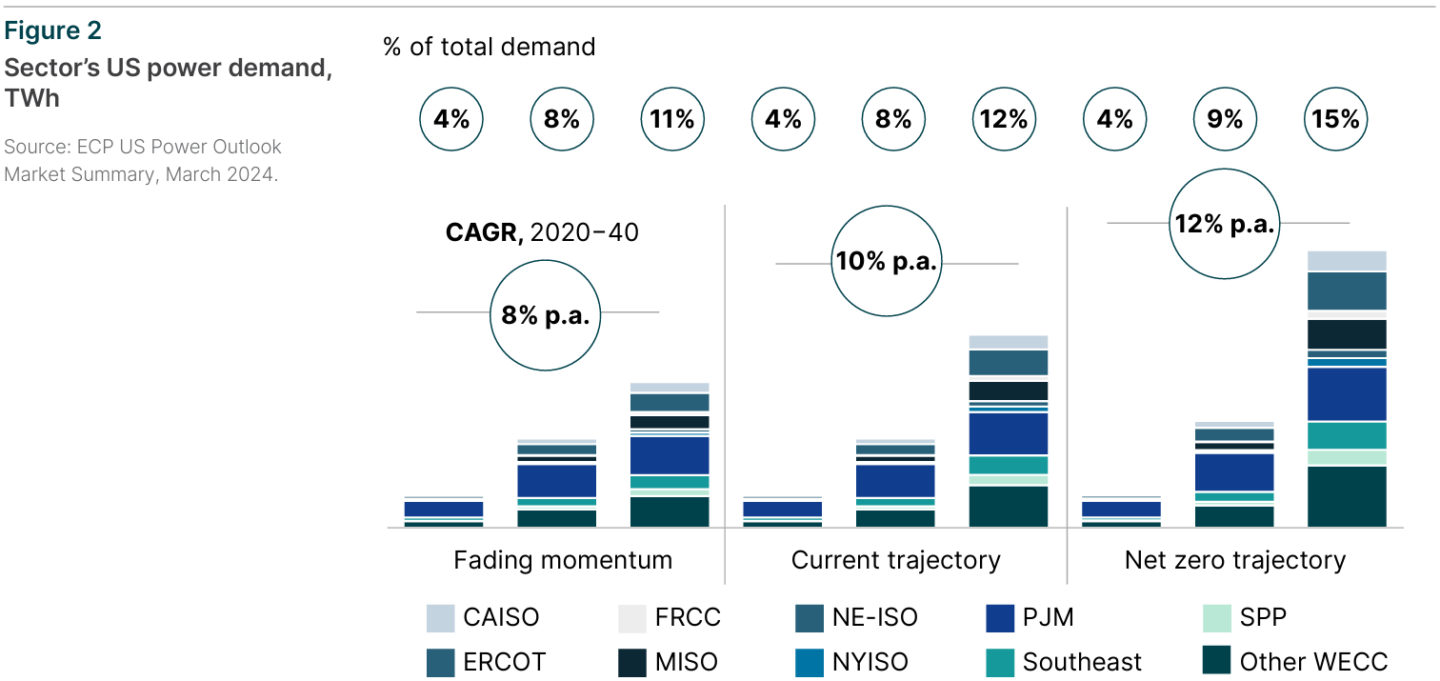
Indeed, by 2030, US data centers are expected to consume more power than many countries, falling only behind China, the US, India, Russia, and Japan.²
For almost 15 years, demand for electricity in the US remained virtually flat as a function of improvements to efficiency, outsourcing of heavy industry, and modest population growth. But looking ahead, that picture is quickly changing.
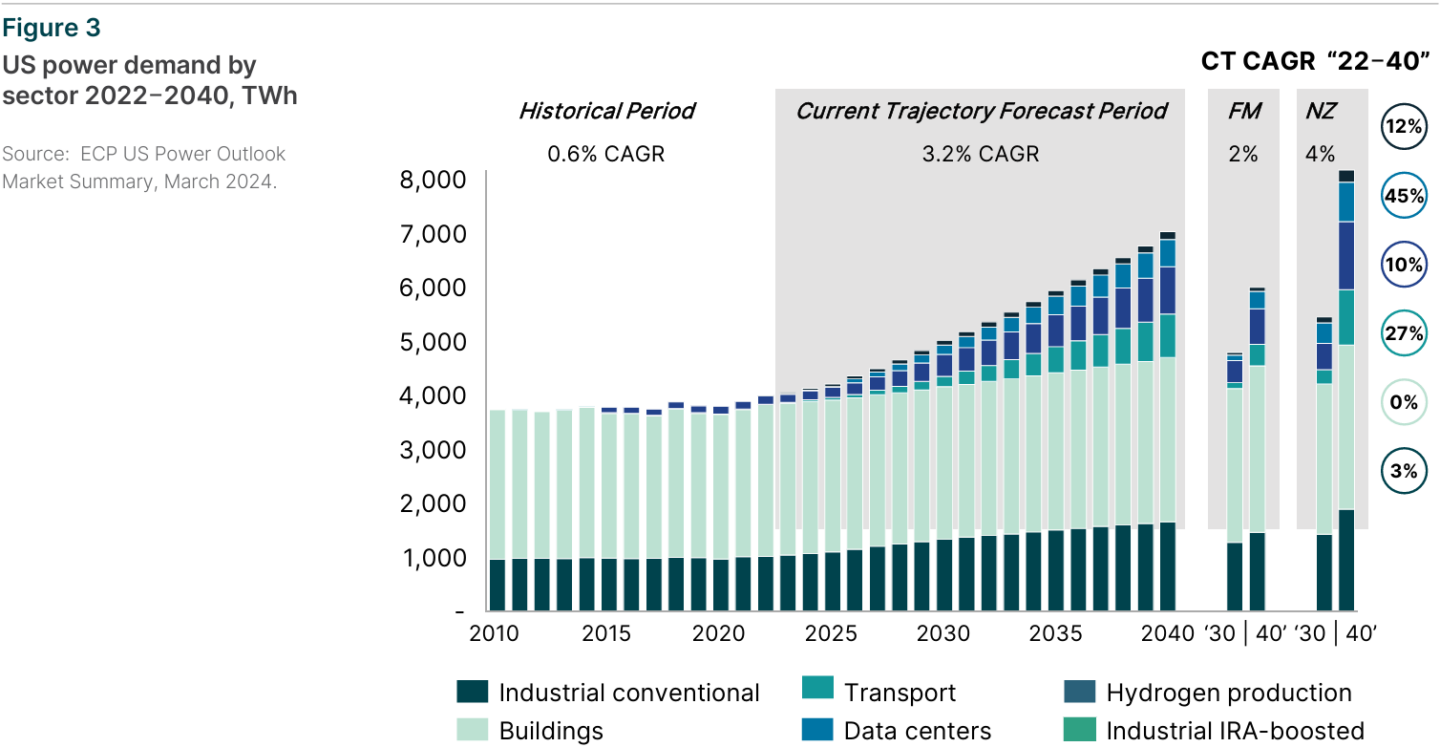
Under the most ambitious net zero scenario, where electrification accelerates and policy support remains strong, the country’s demand for power could grow by around 1.8x. But even in the most conservative case for fading momentum, where progress towards net zero stalls, the growth in demand for electricity could still rise by around 1.5x.
This illustrates how the US is transitioning from an era of stagflation to an era of almost exponential growth in its demand for power. Alongside the electrification of industry and the new large loads required by new tech such as AI and cloud computing, new gigafactories, semiconductor plants, hydrogen production plants, and even electrical vehicle charging facilities are all emerging as additional sources of demand.
This creates an incredibly reassuring backdrop ripe with opportunities for investors considering the US power market. In the last year alone, more than 200 new power manufacturing facilities have been announced, but we still need to see massive investment into the power grid and an adaptation of existing facilities to cope with the higher levels of demand.
Under pressure: increasing outages and regional demand Growth
At a regional level, the projections for the loads to be undertaken by local power systems operators have already grown due to AI and the tailwinds of electrification, with further increases anticipated.
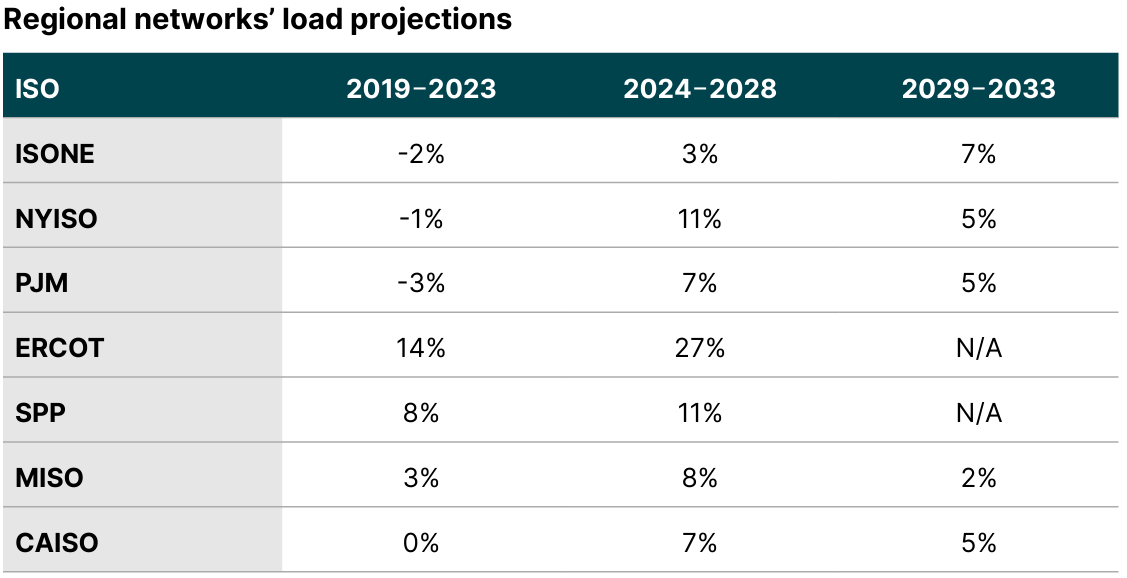
Even some of the most mature markets in the country such a New York Independent System Operator (NYISO) and PJM, are forecasting significant growth after years of flat or even declining demand.
These surging requirements are putting local systems under pressure. The number of annual electrical interruptions, which have increased by around 90% since 2015, highlight the vulnerability of the system.
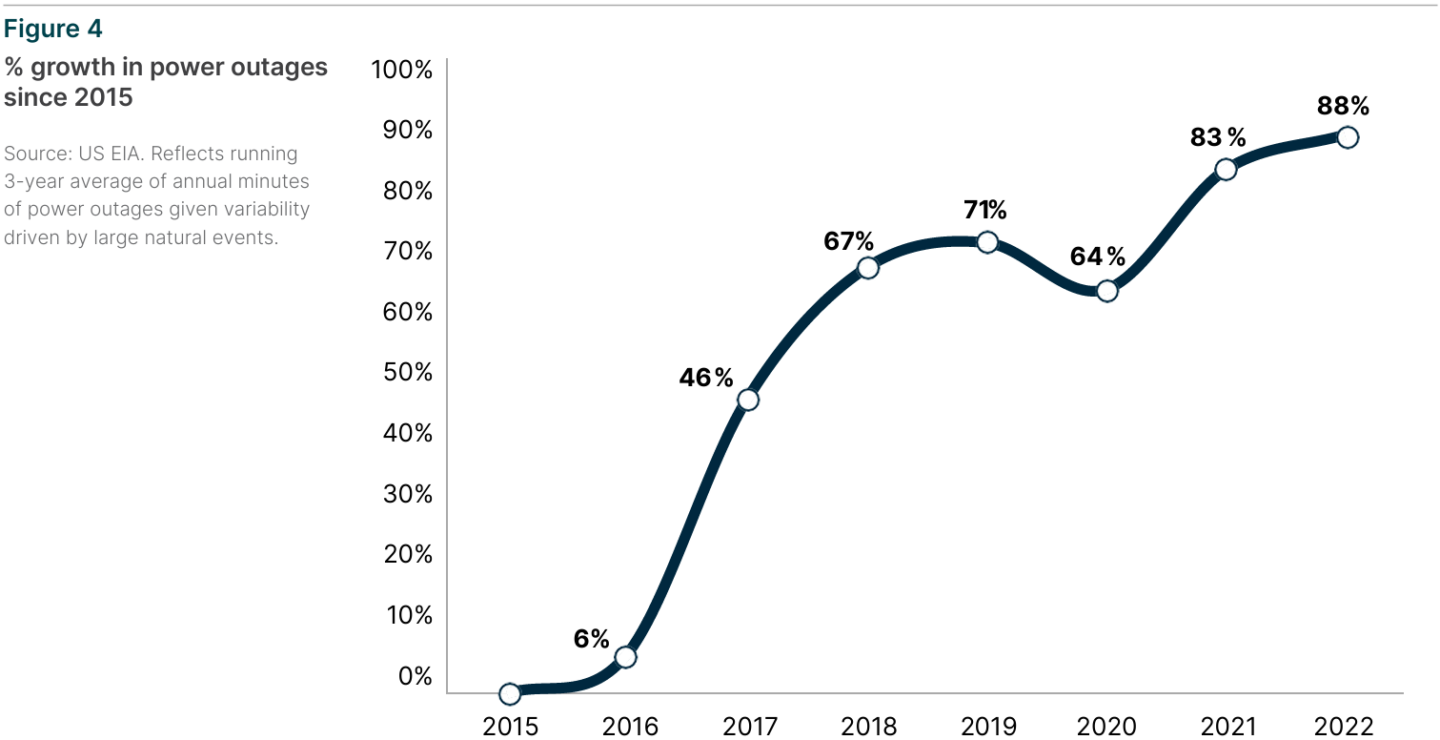
This systemic fragility is not an operational issue, but an investment signal. Capital is needed urgently here, and assets that enhance grid resilience, whether through generation, storage, or transmission, are becoming more valuable.
Where’s the spark? Thermal retirements are outpacing renewables
On the supply side of the market, the challenges are just as significant. The US still relies heavily on thermal generation (the burning of coal, natural gas, nuclear fuel, and so on) for its power.
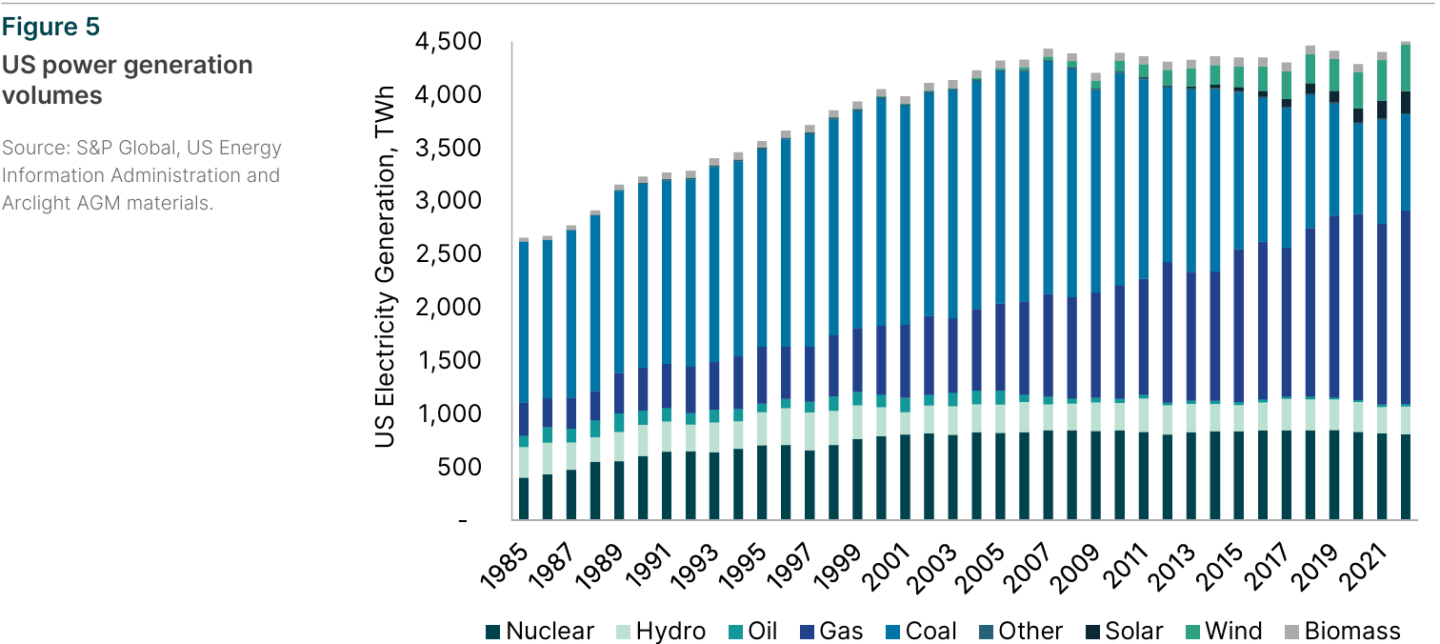
Over the last decade though, some 73GW of thermal generational capacity has retired.
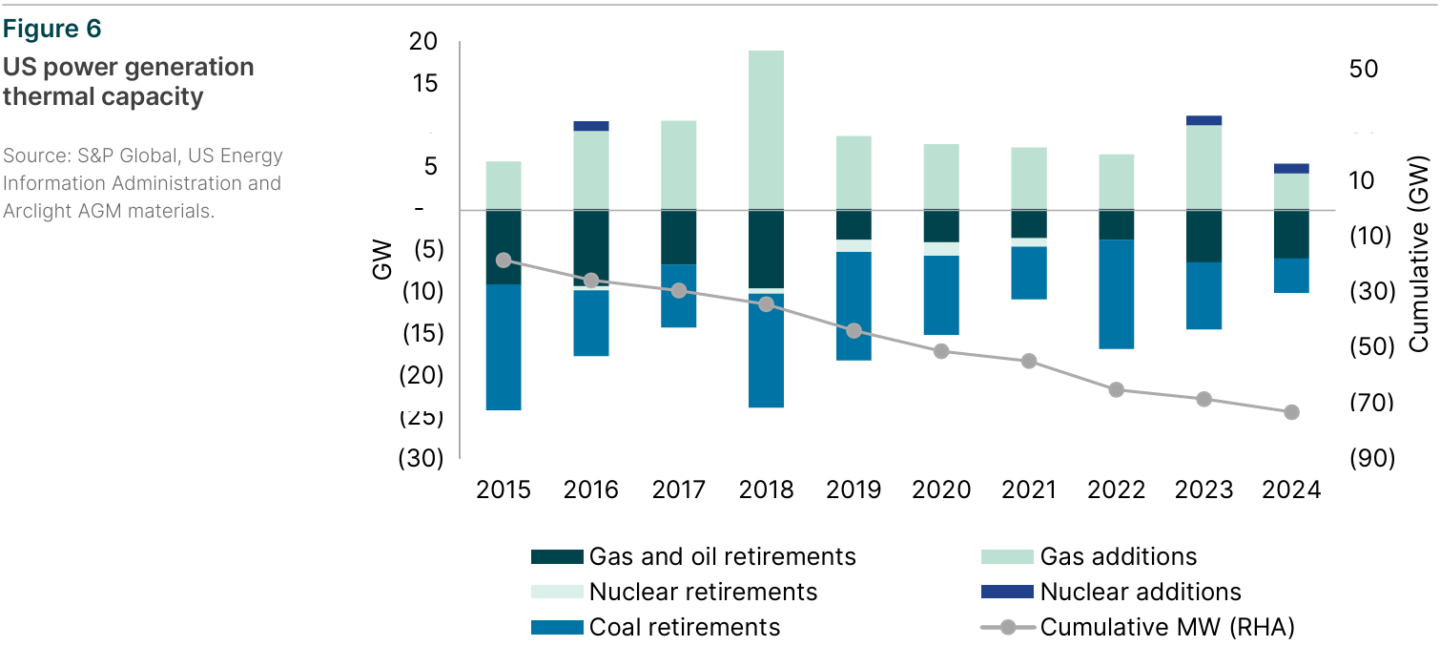
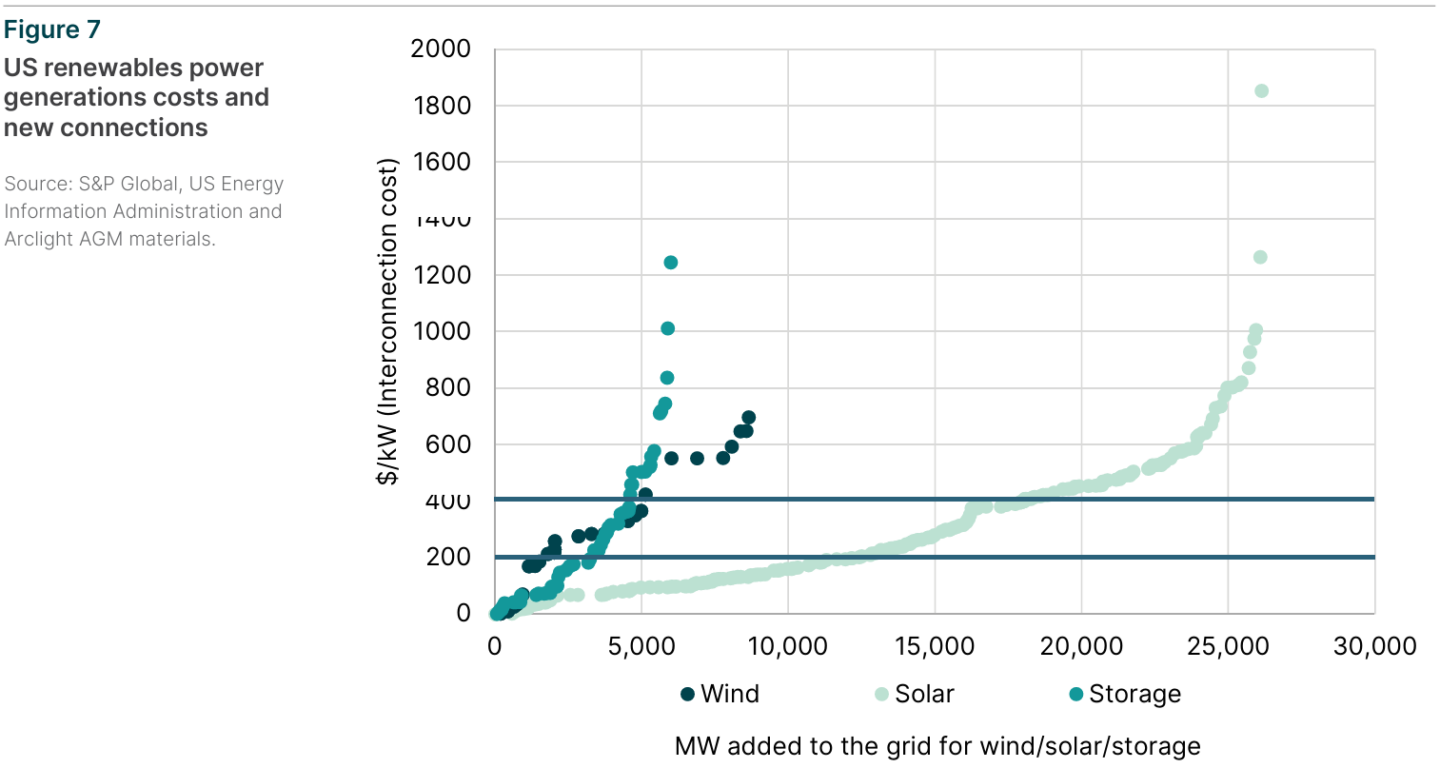
Typically, these retirements would be offset by the emergence of new sources of power, but the pace of replacement has not kept up to speed. New renewables facilities are stalled by high costs, and by grid bottlenecks, with some projects facing costs of hundreds of dollars per kilowatt just to connect to the grid. Some projects’ development timelines are also getting longer given permit and regulatory delays, while new legislations are creating headwinds for renewable development.
This has resulted in a 14% decrease on baseload generation in the last 10 years, just at the moment when demand is rising sharply.
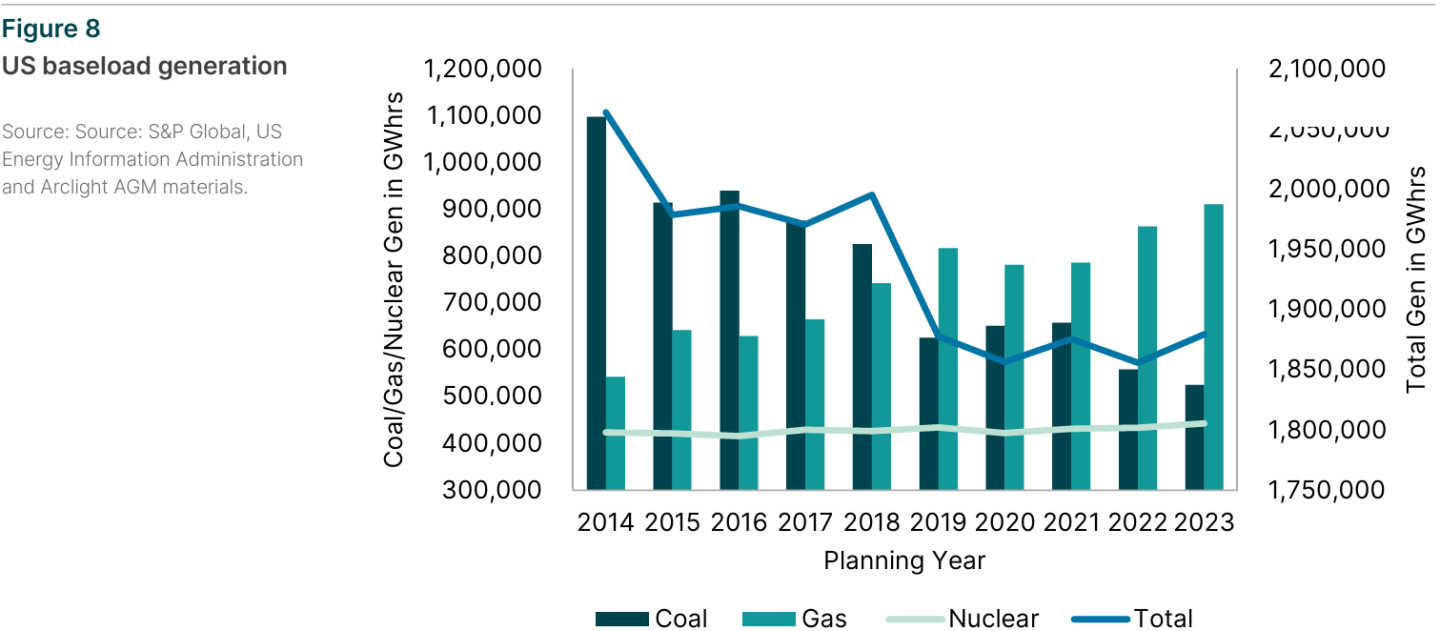
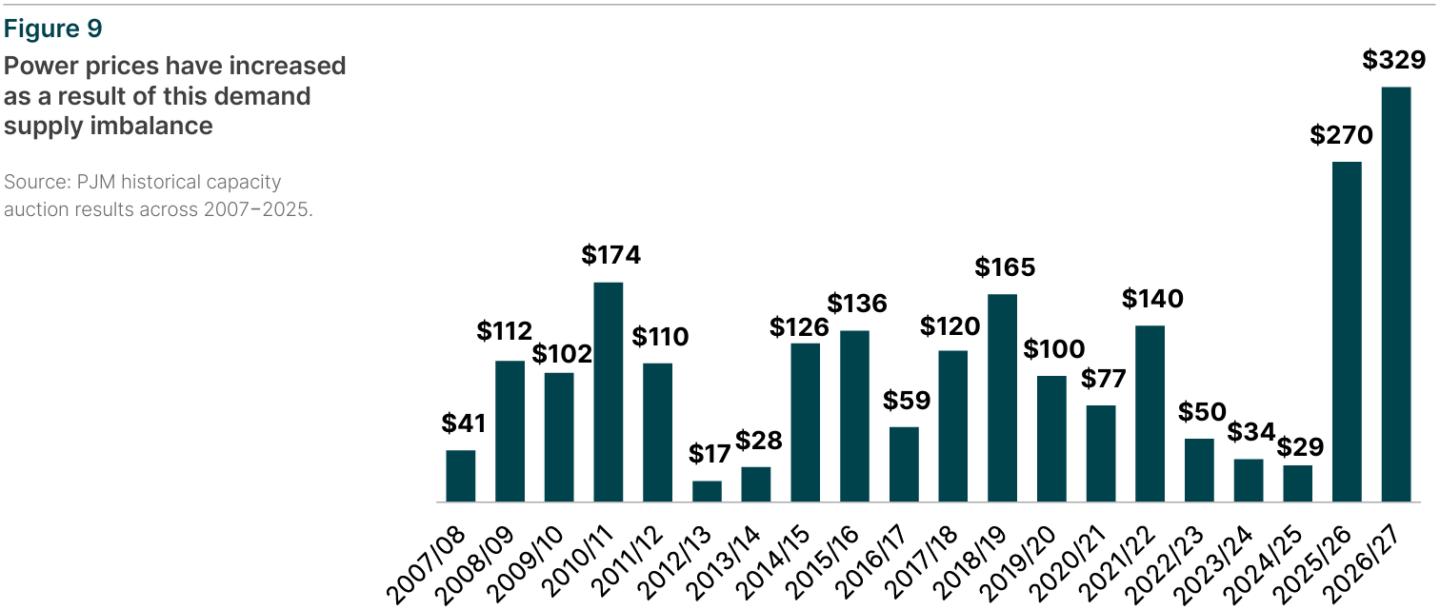
The imbalance between the fall in base generation and accelerating power demand creates both risks and opportunities for investors. Power shortages can destabilize markets, but there is clearly demand for capital to finance potential solutions. The imbalance has also driven an uptick in power prices, as seen in the auction prices cleared at PJM, the largest wholesale market in the US. In 2024, auction prices were clear at a price nearly 9x the levels on previous auctions, and this year the prices have been even higher.
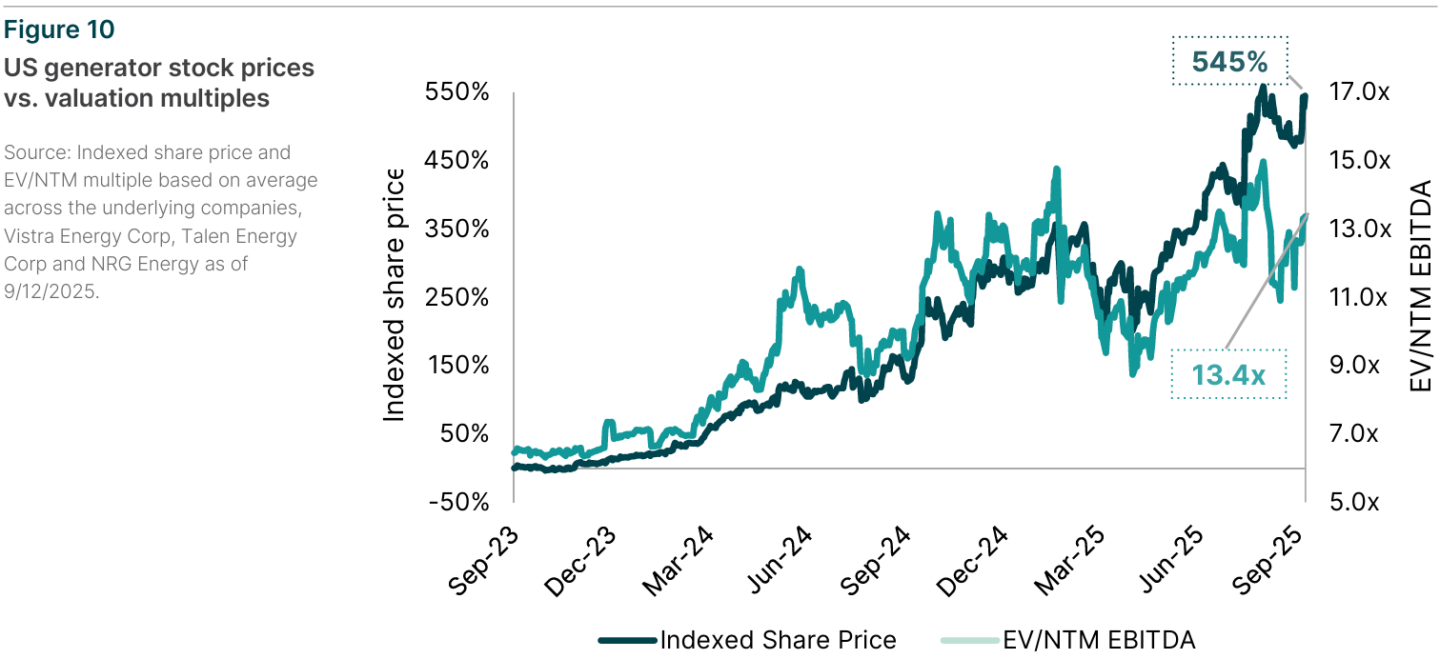
This surge in valuations is emerging in equity markets too, and the stock prices of listed US power valuators have risen more than five times since 2024 as investors recognize the scarcity value of reliable power.
The bottom line: What this means for investors
For investors, this data all illustrates what an interesting time it is to be in the US power market. On the one hand there is a clear signal that fundamentals are strong, and that power assets are becoming increasingly valuable. But on the other, there are stark reminders that investment discipline is important, and that buying blindly at elevated valuations is not recommended.
Investors need to be selective, to structure deals carefully, and to lean on platforms that can identify where the risk-adjusted returns remain most compelling. While the US power market is experiencing a repricing that reflects the real scarcity of assets and the long-term opportunity, the winners that emerge will be those who invest with focus and with discipline.
Conclusion
Over the last year, we have seen a wave of large-scale strategic partnerships that bring together financial sponsors, hyperscale customers, utilities, and developers. For example, KKR and ECP last year announced a $50 billion strategic partnership designed to deliver large-scale data center and power solutions to hyperscale customers’ training, turning, and inferencing needs.
Elsewhere Microsoft, GIP/BLK, and MGX have created a global AI infrastructure investment partnership to make investments in new and expanded data centers, as well as energy infrastructure to create new sources of power for these facilities. This is a $30 billion equity partnership potentially increasing to $100 billion including debt.
It is still early days for these partnerships, and the frameworks are not yet fully defined, but they represent a fundamental shift. Hyperscaled customers are no longer just clients of the grid. Rather they are becoming investors themselves, and in some cases becoming competitors in building out energy infrastructure.
The convergence of capital, technology, and infrastructure in these partnerships is creating an ecosystem of prospects for investors. This is where the lines between technology and infrastructure are blurring, and where these investors may see some of the most exciting opportunities.