By Toni Vainio and Jillian Hostetler | Download this article (PDF)
GP-led deals have long been a feature of private equity, and now they’re reshaping private credit. As direct lending funds reach the end of their legal terms with seasoned loans still outstanding, continuation vehicles, and other GP liquidity solutions are emerging as a structural part of the market. These income-oriented transactions require a sophisticated level of underwriting discipline to evaluate.
In recent years, private credit fund managers (“general partners” or “GPs”) have become increasingly active participants in the secondaries markets. GP-led deals have become a more prevalent way to provide liquidity solutions to existing investors while allowing managers to continue managing portfolios of assets.
GP-led vs. LP-led transactions
In GP-led transactions, a secondary investor acquires a portfolio of existing investments and participates in the structuring of the vehicle, including negotiation of fund terms, portfolio composition, and governance. This differs from limited partner-led (“LP-led”) transactions, where an investor acquires an existing fund interest and assumes the original terms of the investment.
LP-led transactions can be viewed as more standardized transfers of existing interests, whereas GP-led transactions often involve more bespoke structuring and governance considerations, while targeting comparable return outcomes.
GP-led transactions can offer enhanced alignment, governance, and often greater access to information, both pre- and post-investment, than LP-led transactions. They may also provide the opportunity to select, or exclude, specific assets to enhance the overall risk-return profile of the transaction.
GP-led transactions are a well-established feature of private equity markets. More recently, this structure has emerged in private credit markets as well. While the underlying concept is similar (a transfer of one or more assets from an existing fund, vehicle, or balance sheet into a newer vehicle), the application in private credit also has meaningful differences.
Private equity GP-led transactions are typically concentrated investments, often involving a single “trophy” asset or a small number of assets, with returns driven primarily from increases in the equity value of a company at exit. In contrast, private credit GP-led deals typically consist of diversified portfolios of loans to multiple borrowers. These investments are generally income-oriented, with returns driven by contractual cash flows and repayment of principal over time. The need for continuation vehicles (“CVs”) in credit funds is a result of credit funds having recycling provisions and continuing to make new long-dated loans well into their investment periods. The duration of underlying loans, therefore, does not always align neatly with fund-level legal terms, creating a need for GP-led liquidity solutions.
The role of continuation vehicles in private credit
The use of continuation vehicles – typically more complex, bespoke transactions – has increased across private credit secondaries as the market has matured.
Closed-end direct lending funds have finite lifespans, often around seven years, including an investment period of four years followed by a three-year harvest period (with potential extensions). However, the underlying loans in these funds often have longer contractual maturities, and many direct lending funds tend to end their harvest period with a significant remaining portfolio.
As a result, a duration mismatch can emerge between the duration of the underlying loans and the legal term of the fund. Even in well-performing portfolios, a meaningful portion of loans may remain outstanding as the fund approaches the end of its legal term.
This is where continuation vehicles come into play. These structures provide a mechanism to address duration mismatch by transferring the assets to a new vehicle with a more appropriate legal time horizon – and, potentially introducing additional unfunded capital to support continued capital requirements of the existing portfolio not available in the current vehicle construct – while offering liquidity to existing investors.
In a typical continuation transaction, assets are transferred from an existing fund, vehicle, or balance sheet (often in its harvest period) into a newly formed vehicle managed by the same GP. Existing investors are generally given the option to either roll their exposure into the new vehicle or sell their interests at a negotiated price to new investors. The GP continues to manage the assets, typically with updated terms and extended duration.
Continuation vehicle structure & opportunity
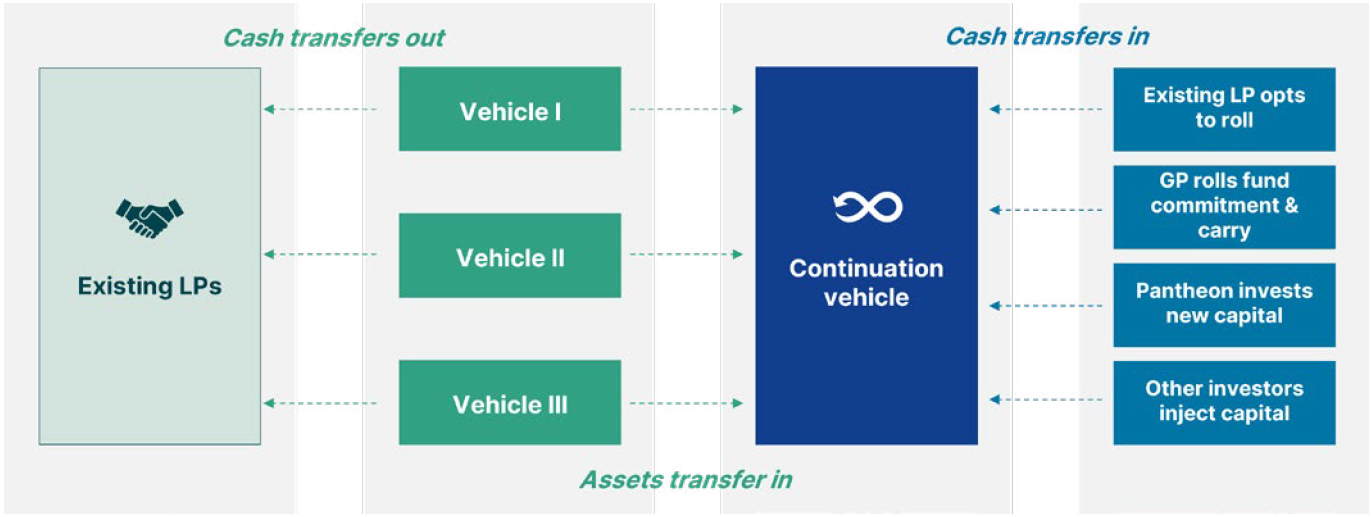
The continued growth of private credit as an asset class, combined with increased investor focus on secondary opportunities, has supported the development of continuation vehicles as a more widely utilized tool within private credit markets.
Types of GP-led transactions
GPs access the secondary market for a range of reasons beyond CVs, including:
Balance sheet optimization: Financial institutions or other holders of private credit assets may seek to transfer exposures into dedicated investment vehicles, often to support capital efficiency or to launch strategies inclusive of third-party capital. Typical sellers include banks, insurance companies (possibly affiliated with a credit manager), and GP stakes firms.
Joint ventures and strategic partnerships: These structures can allow GPs to maintain and grow their asset base, with the potential to scale capital over time. Typical structures involved include joint ventures with evergreen vehicles such as private and public Business Development Companies (BDCs).
Tender offers: GPs may offer liquidity to existing LPs through a tender offer to acquire their stakes in a mature fund, allowing them to either exit or maintain their exposure (with fund economics and structure typically unchanged, though fund terms may be extended).
Strip sales: GPs may sell a defined portfolio of loans from an existing fund or vehicle to optimize diversification or reduce exposure to certain loans.
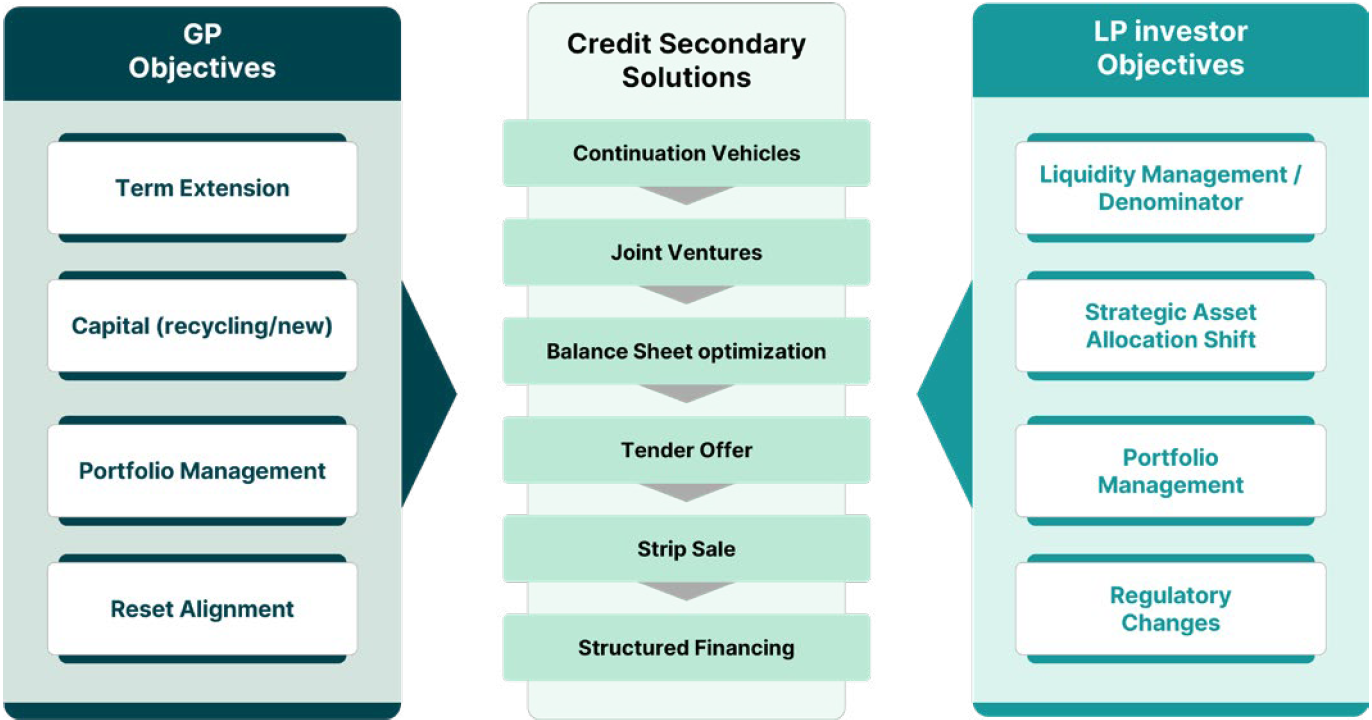
GP liquidity solutions can provide a range of benefits to GPs and investors. Source: Pantheon. For illustrative purposes only; reflects Pantheon’s current assessment.
Opportunity for GP-leds in BDCs, evergreen funds, and interval funds
As of June 30 2025, assets held in evergreen private credit funds, which includes perpetual-life BDCs, interval funds, and tender offer funds reached $644 billion, up 28% from the end of 2024 and roughly 45% year-over-year.1 This sector has continued to experience rapid growth, with asset managers increasingly targeting private wealth investors.2
An additional and growing source of secondary opportunity is emerging from BDCs and evergreen structures. Recent market developments have highlighted the potential for liquidity mismatches within these vehicles, particularly where redemption requests exceed the typical 5% legal quarterly redemption threshold, and/or available liquidity.
In recent cases3, these dynamics have led to the gating or pro-rating of redemptions, creating a need for liquidity solutions that secondary managers can provide.
The continuation vehicle underwriting framework
Underwriting of credit continuation vehicles focuses on both the quality of the underlying loan portfolio and the structure of the transaction.
The evaluation of continuation vehicles covers five key areas:
The private credit distinction
While private credit continuation vehicles can offer differentiated characteristics, they also introduce a distinct set of considerations that require careful evaluation:
These considerations highlight the importance of disciplined underwriting, independent analysis, and alignment of interest when investing in private credit continuation vehicles.
Frequently Asked Questions
How durable are continuation vehicles across cycles, particularly as M&A and exit activity becomes more prevalent in private equity?
Continuation vehicles are a structural and growing part of the market, rather than purely cyclical. While the recent increase in CV volume has been accelerated by slower M&A and exit activity (which has extended hold periods and created a need for liquidity solutions), CVs are likely to remain a core portfolio management tool for GPs. Fund-level decisions (such as recycling, deployment pacing, and use of leverage) highlight the need for liquidity, reinforcing the relevance of CVs across market cycles.
Will the pipeline of CVs grow over time if return dispersion widens?
The pipeline of CV opportunities should remain robust and even grow, particularly in an environment of increasing performance dispersion. Wider dispersion drives two dynamics: firstly, GPs managing stronger-performing portfolios may utilize CVs as a fund management tool, and, secondly, GPs managing more complex assets may use CVs to secure additional time and capital for value creation plans to be effectuated. As a result, both the volume and heterogeneity of CV opportunities are likely to increase.
How do CV investments perform relative to other deals of a similar vintage?
While CV transactions may close in a given vintage year, the underlying assets are typically more seasoned, providing greater visibility into performance. More broadly, CV performance is highly dependent on asset quality, sponsor strength, and transaction structure, reinforcing the importance of disciplined selection.
Conclusion
GP liquidity solutions represent an evolving application of a well-established private markets structure. While they share similarities with private equity GP-led transactions, the underlying exposures, return drivers, and risk profiles of private credit GP-led transactions are distinct.
By providing access to diversified portfolios of seasoned loans, private credit GP-led transactions such as continuation vehicles typically offer investors a combination of income generation, greater visibility into asset performance, and structured entry points into private credit portfolios.
At the same time, these transactions require careful evaluation, particularly with respect to asset quality, capital structure positioning, alignment, and pricing. As the market continues to develop, disciplined underwriting and experience in structuring and executing GP-led transactions will remain important in assessing opportunities.
GP liquidity solutions can serve as a complementary approach within private credit allocations, particularly for investors seeking exposure to seasoned assets with resilient cash flow characteristics.