
By Imogen Richards, Partner | Download this article (PDF)
The structural tailwinds that powered private equity’s golden age of the 2010s have faded. In a more uncertain regime with less structural support, operational value creation and deep specialism matter more than ever, and the data shows specialist managers delivering more consistently than their generalist peers.
It may be that every investor reaches the point in their career where they believe that everything was easier in the good old days. That deals were simpler to find, that there was less competition for transactions, and that returns flowed more easily. But for many of us working in private equity, our recollection of a ‘golden age’ in the 2010s is backed by solid macro data.
In the decade from 2010 to 2020, a number of supportive structural tailwinds converged to create attractive conditions for our asset class.

Rates were at historic lows, cheap leverage was available, and the IPO window was wide open as the S&P 500 tripled between 2013 and 2021.¹ Entry multiples expanded from around 9x EBITDA in 2013 to over 12x by 2021,² and it was this expansion in multiples, rather than operational improvement, that drove a meaningful share of buyout value creation over the decade.
The period also coincided with several years of relative geopolitical calm and strong globalization, meaning that portfolio companies were able to benefit from frictionless trade and labor cost arbitrage, and private equity funds generated strong returns. Between 2012 and 2019, top-quartile funds averaged IRRs of around 20%.³ This ‘golden age’ was the culmination of four decades of compounding macro tailwinds, but those structural supports are now almost all gone, and today’s GPs are operating without that same helpful backdrop.
The times are a-changin’
The investing environment today is not only marked by wider volatility and uncertainty, but there is more competition for deals, debt is more expensive, and growth is harder to come by.
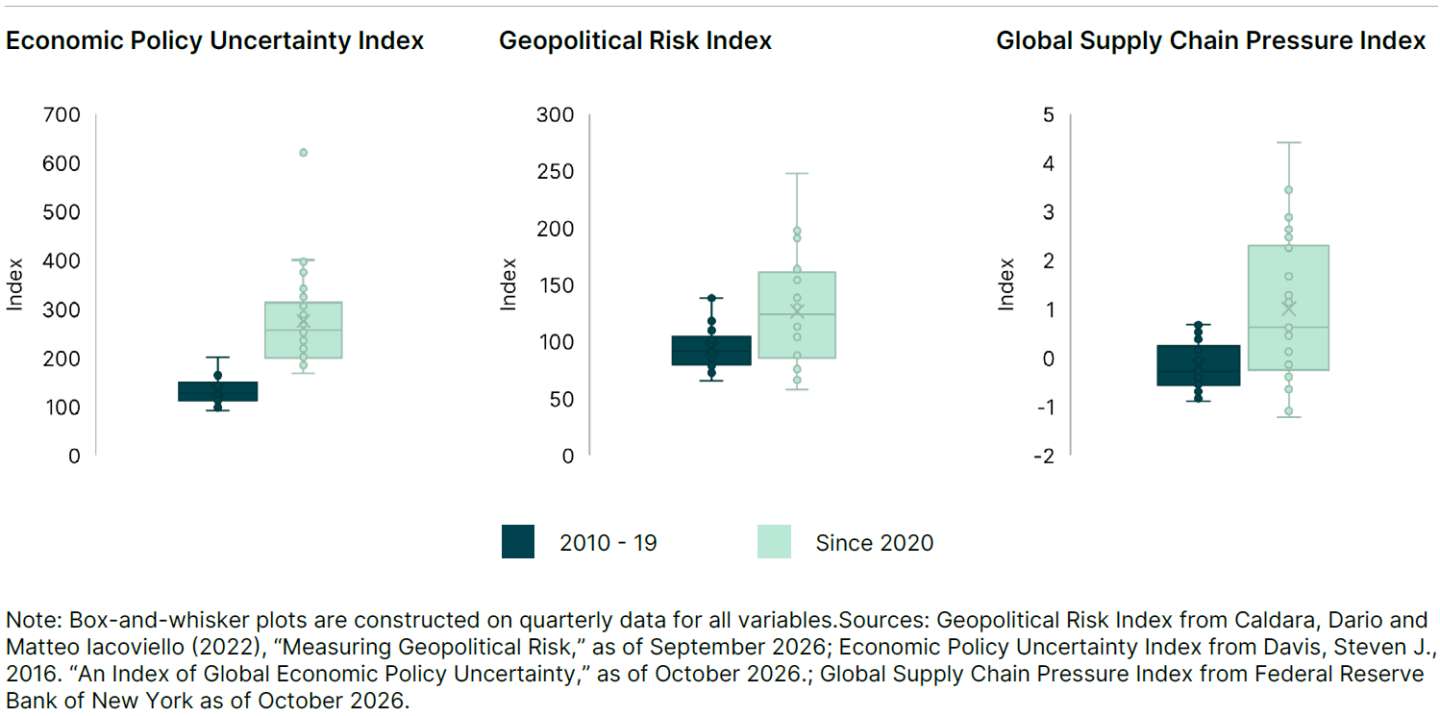
In private equity investments, GPs have to underwrite a wide range of potential outcomes. If the backdrop is more uncertain, that range of potential scenarios is wider, there is less certainty in outcomes, and so there may be less willingness to commit new capital without certainty of downside protection.
In this new normal, GPs are facing an operating environment where hold period assumptions must span a much wider range of potential policy outcomes, where fluctuating interest rates mean that they cannot assume the cost of debt at entry will approximate the cost of debt at exit, and where timing exits is harder and public comparables used to anchor private valuations are themselves more volatile. If portfolio companies have physical supply chains, the shifting tariff environment is translating into margin volatility that is genuinely harder for GPs to hedge against, while capex decisions are more difficult.
A specialist approach
This is not to say that there isn’t still an opportunity to generate strong returns from private equity, but a different playbook is needed. The flat or declining multiples and the higher financing costs we see today mean there is likely to be greater dispersion in the returns of private equity managers, and because the landscape is more uncertain, liquidity around any asset with a more nuanced story is likely to be more challenged.
There therefore needs to be an increased focus on operational value-add, and it is managers with deep specialisms, whether in sub sectors, geographies, or value creation abilities, that are increasingly differentiating themselves from their generalist peers through stronger performance and more resilient value creation.
Specialist vs generalist private equity
Across the 2010 to 2022 vintages, specialist buyout funds generated better returns than their generalist peers.⁴ According to McKinsey research, specialists had higher pooled IRRs than generalists (17% versus 13%), more attractive total value multiples (2.2x versus 2.1x), and lower loss rates (9% versus 12%).⁵
The stronger performance of specialists is underpinned by a distinct focus on operational value creation. Compared with generalist buyout funds across the 2010–22 vintages, specialists generated nearly four times as much equity value from EBITDA margin expansion (43% versus 10%), while delivering a similarly high share of value from revenue growth (86% versus 82%). Notably, specialists’ returns were also largely independent of multiple expansion (5% versus 35% for generalists), highlighting a more resilient and less market-dependent return profile.⁶
None of this is to say that generalist buyout managers are bad, and indeed many of the names that can be regarded as generalists are highly proven and capable GPs that may have specialisms in other areas such as complex transactions or value creation. However, we recognise that generalists are focused on a broader opportunity set than their specialist peers, and may be disadvantaged in sourcing and diligencing opportunities, and ultimately in securing deals.
We hear time and time again from our GPs that their reputation as a specialist in a given industry went a long way to winning over the management team of a company they were trying to buy, whether it was a proprietary or bilateral process or a competitive process.
A specialism is not only an advantage in actually securing an opportunity but then also in adding value post-acquisition, and it is the specialist GPs with proven value creation expertise that can drive real alpha generation.
Clearly, this is a key focus for investors with primary or co-investment strategies, while maintaining relationships with a network of specialist GPs with long experience in accessing difficult to reach assets is paramount for secondaries investors.
Those of us who remember the golden age are right that conditions were easier a decade and a half ago. But an easier backdrop rewarded everyone. Today’s environment rewards the specialist, and that is where the opportunity now lies.⁷