
by Andrea Echberg, Global Head of Infrastructure | Download this article (PDF)
The year to date has been dominated by geopolitical shocks, renewed fears of higher inflation, and fresh tests for the resilience of investment portfolios. In short, another year in the 2020s. It is clear that volatility is not going away; if anything, the pace of change looks set to accelerate. While this will mean further tests of resilience, for infrastructure investors this backdrop also creates a potential source of opportunity.
The first half of 2026 was dominated by global uncertainty, with markets rocked by political tensions, macroeconomic uncertainty, and seismic technological shifts. This continues a narrative seen since the start of the decade. But as an asset class, infrastructure has stood up to these tests and delivered sustained performance across the decade to date.
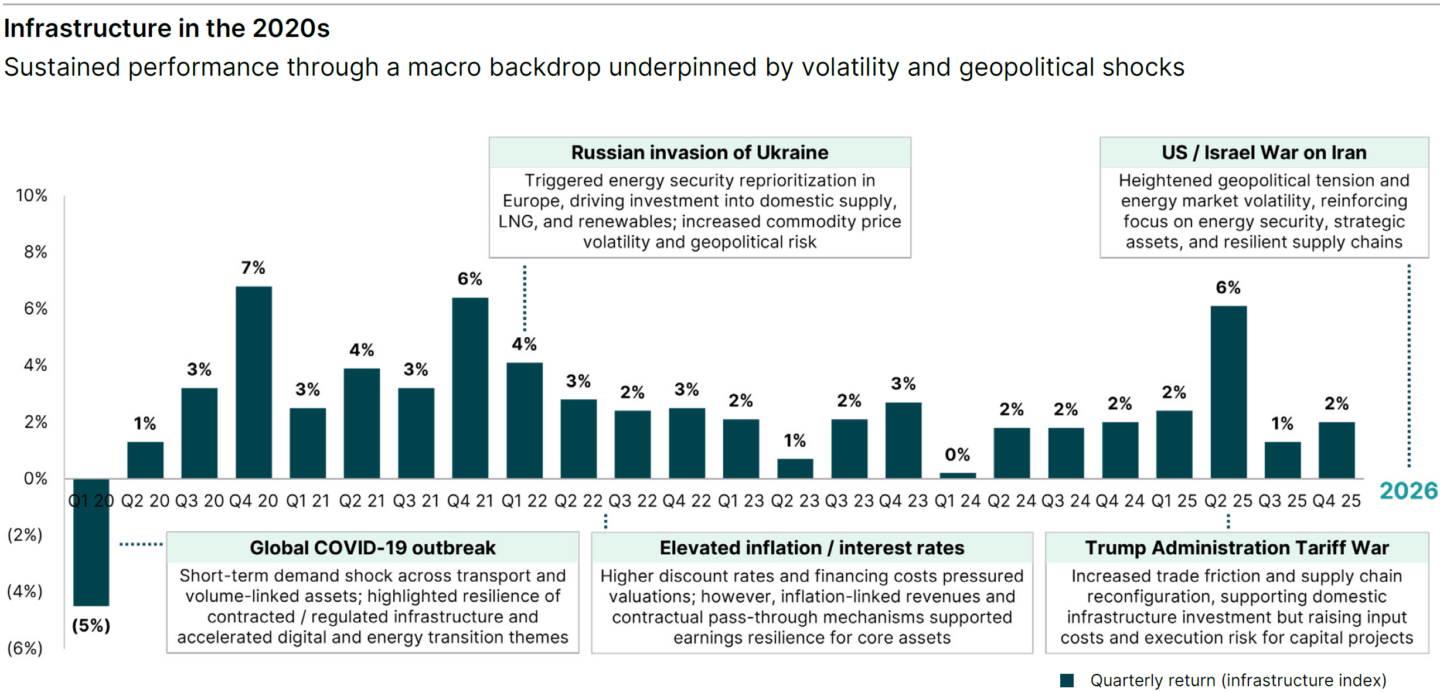
Many of the stresses seen across the last few years have actually provided a tailwind for infrastructure. COVID-19, for example, also underscored the resilience of contracted and regulated assets, and caused a substantial tailwind to digital infrastructure in particular. Elsewhere Russia’s invasion of Ukraine, tariffs, and this year’s Middle East tensions triggered a major reprioritization around energy security. This emphasized underlying infrastructure investment themes including the importance of supply chain resilience, the strategic value of certain asset types, and the case for funding domestic energy supplies, LNG, and renewables.
Similarly, uncertainty around the inflation outlook back in 2022 fortified the case for the inflation-linked revenues and contractual pass-through mechanisms inherent in infrastructure. Given these concerns have materially increased again in the first half of 2026, this backdrop could again prove positive for infrastructure assets.
Fundraising and the rise of secondaries
It is infrastructure’s durability through times of uncertainty that has ensured that primary fundraising has remained resilient so far this decade, even during a wider slowdown in fundraising. With infrastructure’s defensive characteristics and inflation protection becoming increasingly sought after for investors’ portfolios, global AUM reached $1.7 trillion in 2025.¹
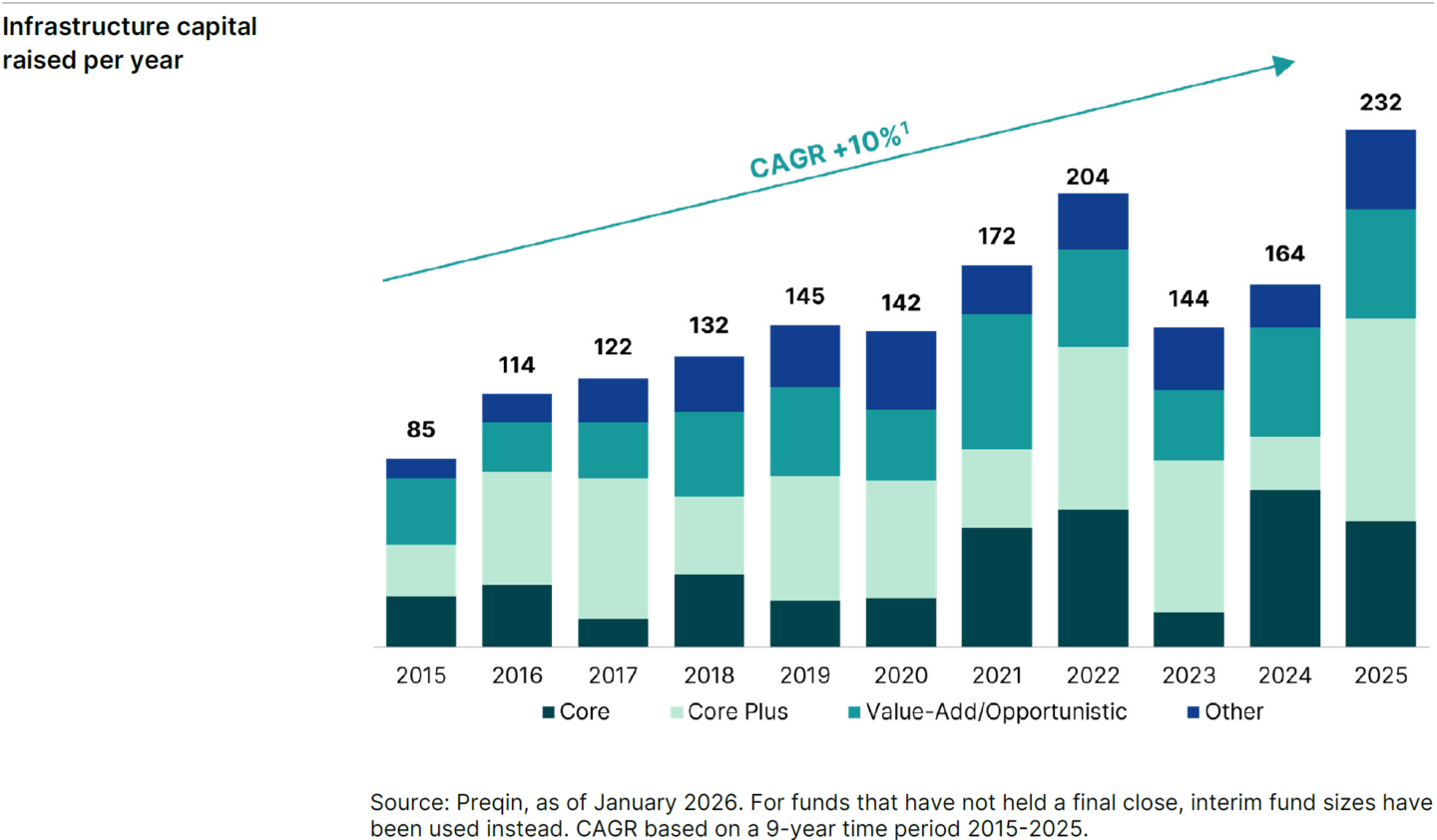
This growth in primary infrastructure fundraising has also driven an increase in secondary market deal-flow, with this part of the market becoming an increasingly compelling way for investors to access infrastructure’s defensive characteristics.
As a result, the infrastructure secondary market has also evolved from a relatively niche liquidity option into a much more strategic tool. Infrastructure secondaries are becoming markedly more institutionalized, while seller motivations have broadened, shifting from distress-driven sales toward proactive portfolio and liquidity management.
As a result, the scale of the market has grown significantly, with more players, more sophisticated secondary buyers, and much more consistent deal flow. In many respects, the market today resembles private equity secondaries fifteen years ago: still meaningfully under-penetrated with favorable supply-demand dynamics and consistent deal flow, making for attractive entry points for capital.
The supply-demand imbalance continues to drive a discounted market, and while exit activity showed some signs of recovery in Q4 2025, the macro uncertainty in the first half of 2026 has again widened the bid-ask spread and dampened M&A activity, especially in the US.
Over the past five years, the sheer volume of LP-led deal flow has to some extent crowded out GP-led activity. That appears to be changing. Pent-up demand for GP-led structures is now surfacing, offering access to assets tied to current thematic priorities, particularly power generation and renewables. Often this is through continuation vehicles and other liquidity structures in partnership with mid-market managers seeking growth capital.
Continued volatility in capital markets is likely to support both LP-led and GP-led opportunities, particularly against a backdrop of delayed M&A activity and heightened liquidity demand across private markets. As always, deals require careful underwriting of asset quality, deal rationale, and alignment between sponsors and investors.
Investing in Constraints, Not Exuberance
One of the most remarkable developments of recent years – and a theme that continued to dominate over the first six months of 2026 – was the growth of AI. AI continues to drive tailwinds in certain subsectors of infrastructure, not least the buildout of digital infrastructure. But while datacenters are sometimes at the heart of discussions around the AI goldrush, it is important to examine where capital is needed to fix a bottleneck to growth, as this can often be where the most interesting investment opportunities emerge. For AI, the greatest limitation to the market’s development is not in capital or computer capacity, it is in power. Power interconnection queues, grid capacity, supply chain bottlenecks, labor shortages, and contractual structures all constrain how AI can effectively grow, and it is in these areas where we see the most exciting investment opportunities.
Distinctions like this matter because the AI-adjacent subsectors of the infrastructure market have become considerably more crowded. Dispersion between high-quality assets and weaker opportunities has widened accordingly, and thorough diligence has become even more important as capital continues to flow into digital infrastructure. Discipline on entry multiples and a focus on the strength of contract counterparties, including hyperscalers, are increasingly what separates durable investments from speculative ones.
Balanced Optimism
With many of the forces that shaped the market last year still firmly in place, we believe the opportunity set for infrastructure investment continues to look robust. AI adoption, datacenter build-out, rising power demand, and continued renewables penetration are all still driving capital flows, alongside longer-established themes like digitization, the energy transition, and near-shoring.
As we move through the second half of 2026, the macro backdrop has made durability and downside protection central priorities for portfolio construction. Expectations for higher short-term inflation meanwhile have reinforced investors’ preference for assets with positive inflation correlation. Infrastructure’s core characteristics of stable, predictable cash flows, strong downside protection, and inflation linkage have proven their worth in recent years.
Infrastructure investors should therefore approach the rest of this year and beyond with a sense of balanced optimism, looking to benefit from a maturing and increasingly institutionalized secondary market and a growing number of GP-led opportunities that offer access to AI-related themes like power generation. At the same time, the prevailing exuberance and uncertainty make this an environment where vigilance and discipline is as important as ever.