by Victor Mayer, Head of International Private Wealth | Download this article (PDF)
Open ended funds, commonly known as “semi-liquid” funds appear to offer investors a way to access the benefits of the private markets alongside more opportunities to redeem their cash. But appearances can be deceptive. Including secondaries in a portfolio may help to boost liquidity, and go some way to provide investors with the flexibility they seek.
The benefits of private markets have been well publicized over recent years, but there has been some caution about the inherent illiquidity of the asset class. So the growing popularity of semi-liquid funds – funds that seem to offer the best of both worlds – is perhaps no surprise.
These funds seem not only to provide an opportunity to access the usually hard-to-reach asset classes of private equity, private credit, and infrastructure, but also promise periodic (usually quarterly) redemption opportunities.
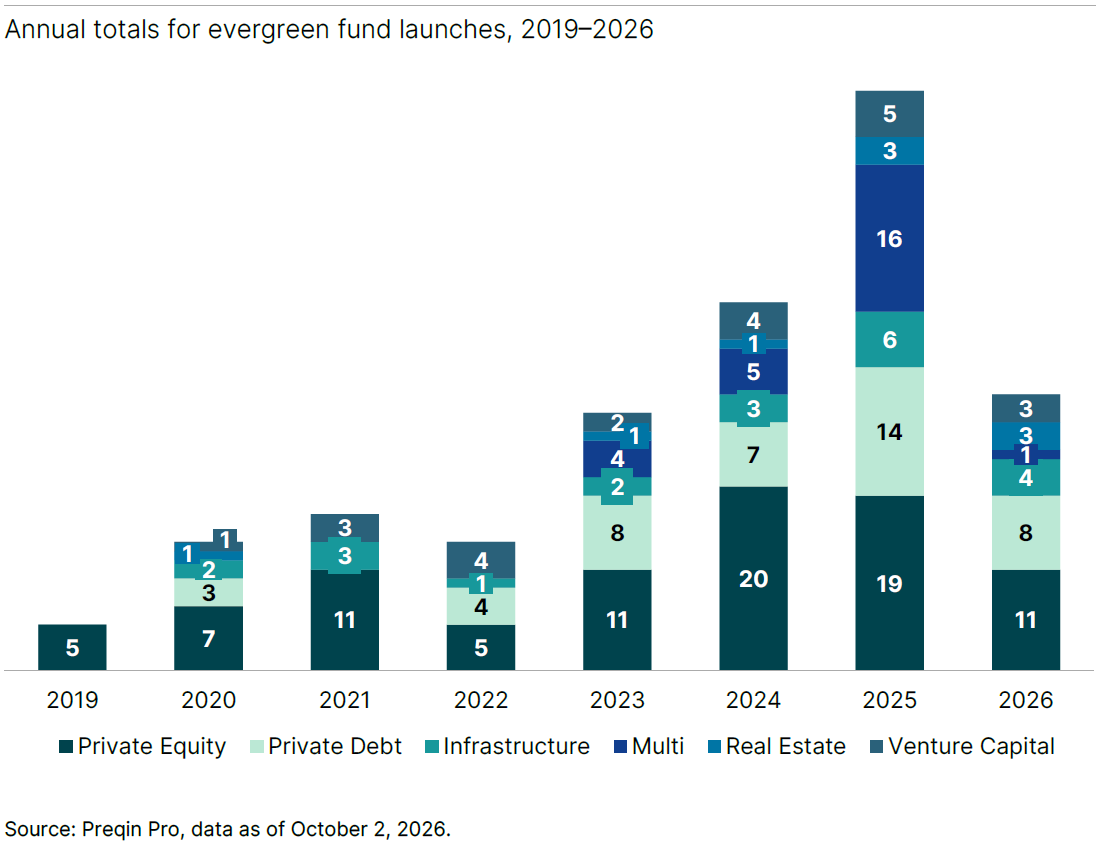
On the surface, a fund with semi-liquid branding may give investors some comfort that they will be able to more easily redeem their holdings. However, the reality of these structures is trickier. Certainly, semi-liquid funds are less illiquid than other private markets structures, but they are far from liquid in the way that most investors would understand the term.
In actuality, the liquidity of any given semi-liquid fund can vary dramatically depending on the asset classes included in the portfolio, given that each product has different market depths, structures, and cash flow timing. In particular, semi-liquid funds that are heavily reliant on primary or direct infrastructure, or on private equity buyout, may seem more liquid, but can be anything but – especially during times of market stress.
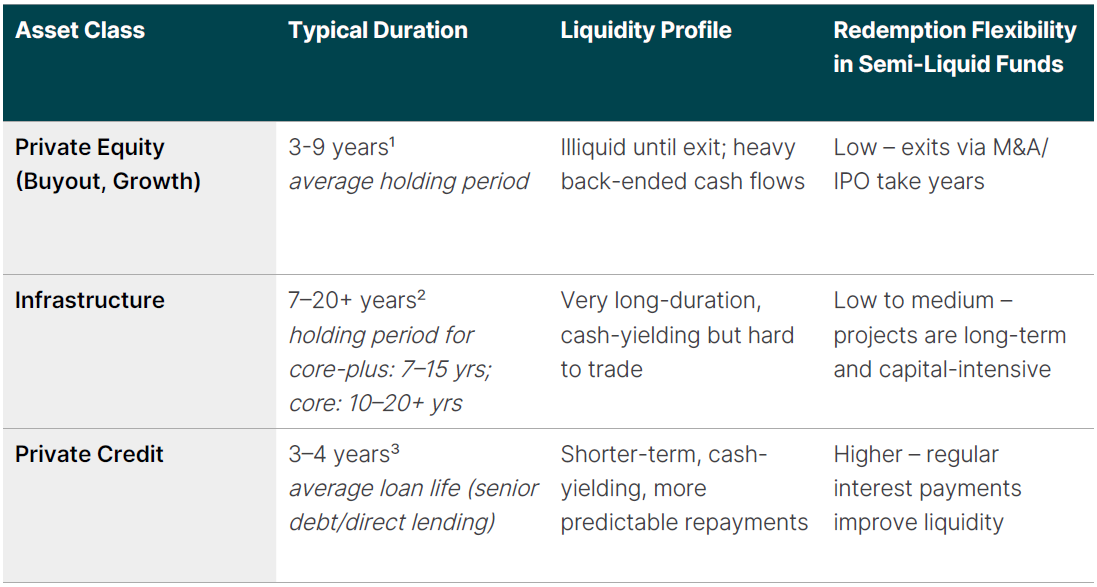
Regardless of the asset class make-up, the quarterly redemption windows offered on some semi-liquid funds may open less frequently than some investors expect.
Certain funds may gate redemptions when too many investors want to leave the fund, while others rely on slow-moving NAVs, which lag market volatility. Semi-liquid funds may also hold back-ended private equity exposure, which contributes little to actual proceeds.
All of these factors may create higher duration risk for investors, and the ability to access capital may not match the timelines expected or the drawdowns being made across the rest of their holdings.
Secondaries smooth the way
But there is a simple way to make a semi-liquid fund liquid in more than name alone. The inclusion of secondaries in a portfolio can have the effect of smoothing duration, generating cashflow, and enabling redemptions.
Secondaries acquire existing investments that are closer to their exit points, so cash flows may come back to investors sooner.
Similarly, because secondaries buy into seasoned funds, less capital is tied up in early-stage investments and there can be more near-term NAV support. This is because while secondary pricing reflects current portfolio values, there is more stability in the NAV.
Secondary managers can also sell their holdings on the secondary market again, creating the option for more liquidity and a natural rebalancing within the fund.
Buying private market assets via secondaries also materially reduces the hold periods required, although this varies from asset class to asset class.
If bought as a secondary asset, the liquidity profile of private equity holdings (whether buyout or growth) can be tightened to three to five years from four to seven years, with distributions brought forward.
Similarly, the liquidity profile of infrastructure assets can come down to four to six years from eight to twenty if accessed via secondaries, dramatically reducing the duration of the asset class.
Finally, the liquidity profile of a private credit secondary asset can be as short as two to four years from three to seven years, meaning that up to a third of an investor’s portfolio may be returned in cash each year.
For any investor looking into a semi-liquid fund, it is important to ask not just if it offers quarterly liquidity, but how it delivers it. How much of the portfolio is in secondaries or in short-duration assets? How cash-yielding is the fund? Are redemptions met through distributions, or via new investor inflows? What happens if those inflows stop?
We have no doubt that semi-liquid funds can be powerful tools for investors to utilize, as long as they are structured thoughtfully. When they are packed with long-dated, slow-moving assets, they risk becoming optically liquid but functionally illiquid. It is the addition of secondaries deals in the portfolio that can boost benefits for investors, and put more of the liquid into semi-liquid.
More from our Decoding Private Markets series
Are you getting real access — or just buying the hype?
Why access to everything is not access to alpha
Recycling over raising: The compounding edge in evergreen and secondary funds
Understanding structures in private markets: Blending open- and closed-ended funds