by Victor Mayer, Head of International Private Wealth | Download this article (PDF)
In an environment where clients increasingly demand liquidity, consistency, and compounding from their private market allocations, the real differentiator among evergreen and secondary strategies isn’t fundraising prowess, but capital efficiency. And at the heart of capital efficiency lies one powerful but underappreciated feature: recycling.
For private wealth investors assessing evergreen vehicles, understanding how – and how well – a strategy recycles capital can offer critical insight into its long-term sustainability and return profile. Recycling involves reinvesting distributions from earlier exits back into new opportunities within the same fund, without the need for new capital inflows. In closed-end structures, capital is typically returned to investors once an asset is exited, but in open-ended evergreen formats, that capital can be re-deployed, often quickly, into new opportunities.
How can recycling be powerful?
- It avoids dilution: Managers don’t need to issue new units or bring in new investors, preserving the value of existing holdings. Recycling is the opposite of fundraising dilution.
- It compounds NAV more effectively: Reinvesting investment proceeds allows for gains to compound within the same portfolio.
- It enhances portfolio balance: By maintaining a consistent vintage profile, it can reduce concentration risk.
- It reduces cash drag: Idle capital is minimized, and investment activity remains steady, even without ongoing fundraising.
For private wealth investors seeking steady exposure to private markets without the commitment cycles of traditional closed-end funds, recycling can keep the engine running.
The hidden cost of constant fundraising
Recycling is especially important in open-ended evergreen structures, where a single capital call is typically made up front, and managers have an ongoing need to maintain investment activity without constantly going back to investors for greater commitments.
Because while bringing in new capital may seem like a positive endorsement of the manager and the strategy, from a performance perspective, mid-cycle fundraising can introduce a number of structural frictions:
- New investors may dilute returns for existing LPs unless capital is deployed immediately into similarly priced, high-quality deals.
- The J-curve effect (or at least a softening of returns) can re-emerge, delaying returns and compounding.
- Issuing new shares or units can introduce complexity around valuation, fees, and liquidity management, especially if redemptions aren’t well managed.
Some evergreen managers, particularly those running single-GP structures, are transparent about the above, acknowledging that fresh capital can create temporary headwinds. But even then, private wealth investors should scrutinize how effectively the strategy uses its own cash flows before relying on external inflows to sustain activity.
What high-performing evergreen strategies do differently
The strongest evergreen and secondary strategies are less likely to rely on external capital to grow. They generate early distributions, often via secondaries or shorter-duration private credit, and reinvest those proceeds into similarly priced, high-quality assets.
When done well, this creates a harmonious cycle
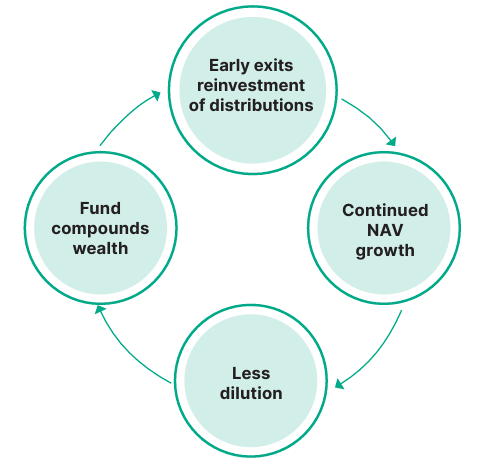
This compounding effect is especially powerful in portfolios with a strong allocation to secondaries, where assets are often acquired closer to maturity and can be more predictable in how they generate liquidity.
In practical terms this can mean:
- Fewer capital calls
- Less dependence on market timing
- More consistent NAV growth
- Greater alignment with client-outcome objectives
What fund selectors should watch out for
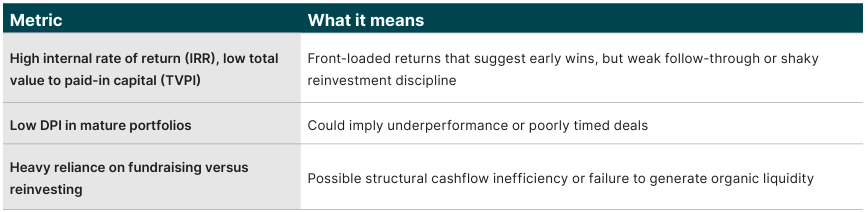
While recycling is a hallmark of efficient fund design, not all recycling strategies are created equal. There are certain warning signs that may suggest the strategy may not be sustainable:
Additionally, while secondaries can support recycling, not all discounted deals are value-enhancing, so investors should be cautious of secondary funds chasing deep discounts. While the discount may look attractive, if the underlying assets are low quality or highly illiquid, the result can be poor recycling capacity and weak long-term performance.
A final thought: look beyond IRR, and ask how they recycle
The smartest evergreen strategies understand that capital efficiency drives investor outcomes.
The highest-performing evergreen funds don’t simply distribute gains, they recycle and grow, recognizing that capital efficiency drives investor outcomes. They avoid the dilution, drag, and complexity of constant fundraising, and instead focus on building a compounding machine from within.
- Investors looking to identify these funds should ask: How does the manager generate and use internal liquidity?
- Is the strategy designed to recycle capital, or to raise it?
- How is dilution managed as the fund scales?
In evergreen investing, the focus should not just be on how quickly capital is returned, but how that capital is actively managed. The best strategies don’t just return capital, they compound it.
More from our Decoding Private Markets series
Are you getting real access — or just buying the hype?
Why access to everything is not access to alpha
Beyond IRR: Where to look for real performance in private markets
Understanding structures in private markets: Blending open- and closed-ended funds